
What is Anger Management Therapy?
You can't get rid of or avoid the things or people that enrage you. But you can learn to control your reactions to them.
I work on a one on one basis with people who struggle with problem anger to ensure that they have a complete and personalized plan to deal with their anger. Using a practical, step by step approach I will help you learn not only how to stay calm in triggering situations, but what to say or do to avoid those situations in the first place.
Anger Management therapy is usually short-term (10 one hour sessions) and is oftentimes health insurance reimbursable.
What You Will Learn:
1) This is Your Brain; This is Your Brain on Anger – The first part of the course teaches you that anger is a protective response to a perceived hurt or threat which is left over from our days of living in the wild. You’ll also learn how to use anger as a warning sign to begin using some of the skills described below rather than simply reacting.
2) Calming the Emotional Brain - This portion of the course will teach you how to monitor your feelings throughout the day so that anger doesn’t build and lead to an explosion. You will learn 5 simple techniques to relax you in minutes when your stress level begins to build.
3) Undoing Reflexive Anger - Will teach you techniques on how to stop those reflexive 0 – 60 anger responses. You will learn to control your anger instead of feeling like its taking you on an uncontrollable ride.
4) Understanding Your Triggers: The Illusion of Control – There are typically one or two categories of situations that cause people to become angry. In this portion of the course we will learn what the categories are that trigger you and why they have such a powerful impact on you. We will also look at how we oftentimes rationalize anger as a way to regain control of a situation, but how much of an illusion that usually is.
5) Stinking Thinking: How Our Thoughts Add Fuel to the Fire and How to Deal with it Differently: While we like to think that we are fully aware of everything that is happening to us and that we are fully processing all events, the reality is that our brains would very quickly go into overload if that were the case. Most of the time we use mental shortcuts to help cut through the clutter. People with anger problems typically have two or three mental shortcuts they use that cause them to perceive situations in a way that leads to them becoming angry. This two session portion of the course will help you identify what your mental shortcuts are and show you different ways of thinking about situations that will leave you in control and empowered.
5) The Power of Empathy : How to Kill ‘em With Kindness and Get What you Want : The most powerful way to get someone to listen to you is to make them feel like they are being heard. This portion of the course will teach you a simple and compelling technique that will let you leave you feeling calm, respected by the other person and in a position to lead the conversation where you would like for it to go.
6) Forgiveness - How do you move beyond old wounds that keep piling up? This portion of the course will show you how.
7) Identifying Poor Communication Patterns - This portion of the course will help you to identify communication patterns that you may be using that are inadvertently causing others to think you are being aggressive.
8) Responding to Criticism – Criticism, whether deserved or not, is something that most people have a hard time dealing with. This portion of the course will teach you 3 specific strategies on how to respond to criticism in a non-threatening manner and which enables you to present your perspective in a way that will be heard by the person criticizing you.
9) How to Deal with People You Can’t Stand - In all of our lives there are people who, no matter how we try, we just don’t like. It might be something that you just can’t put your finger on or it might be something about their personality, perhaps they are manipulative, untrustworthy or passive aggressive. This portion of the course will identify 10 specific personality types and show you ways to deal with them in an effective manner
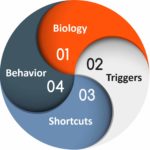
The Four Horsemen of Anger
What makes an angry person angry? After years of research and working with literally hundreds of clients I have come to believe that there are four factors that go into creating an anger problem. I've built my course around these four factors.
1) Biology. There are parts of our brain whose job is to determine if a situation is dangerous or threatening. Many people who struggle with anger have an overly sensitive "threat filter" which puts them on high alert before they have had a chance to really think a situation through.
2) Triggers. Why is it that something that is very upsetting to one person but not another? Oftentimes it is related to our history. Through experience, each of us has learned to perceive certain situations as threatening or triggering. Since we have all had different experiences we each see different things as upsetting.
3) Shortcuts. Ever get angry about something only to learn later that you read the situation or other person wrong? Did you know that much of the time we use mental shortcuts to figure out what is going on around us? Usually, these shortcuts are very efficient ways of dealing with life. After all, if we really thought in depth about everything going on around us our brains would very quickly become overwhelmed. The problem with mental shortcuts in those with anger issues is that they lead you to either misperceive a situation or they give you tunnel vision and limit your ability to think through all your options.
4) Behavior. Insight and self management skills are important, but only half the battle. The final piece of the puzzle is dealing with other people. How do you talk to a difficult person in a non-confrontational way? How do you ask someone to change an annoying behavior without provoking a fight? How do you gracefully exit a tense situation? How can you discipline your kids without yelling?
The "Anger Dirty Dozen"
Answering "yes" to any of the following questions may be a sign of a serious problem with anger.
1) Do you find it difficult to remain calm when someone has an opinion which differs 

from yours?
2) Do people describe you as two different people - a "Dr. Jeckyl" when calm and a "Mr Hyde when angered?
3) Do your spouse and/or friend avoid conflict with you?
4) Are you a "yeller"?
5) Would others describe you as "prickly" or "too sensitive"?
6) Have you ever become so angry at someone in traffic that you cut them off, tailgated or rolled down your window to yell at them or made an obscene gesture?
7) Have you ever surprised yourself by how angry you got or what you did while angry?
8) Have you ever broken an object (glass, table, chair, ashtray, punched a wall) during an argument?
9) Has anyone ever said that s/he is afraid of you?
10) When angry have you ever raised your hand or shaken your fist at anyone?
11) Have you ever slapped, hit or laid hands on other person when angry?
12) Has anyone ever suffered an injury of any sort as a result of your anger?
Please feel free to contact me with any questions or to schedule an apppointment!
“Shattered relationships, broken families, friendships in ruins, job loss, jail time, embarrassment”
In all my years as a psychologist specializing in anger management I have heard client after client describe the losses their anger has cost them. Through all the pain, the one consistency I have heard is how misunderstood most people with problem anger feel. The trouble for many is not the point they are trying to make, but the way they are trying to make it. Its rare that I treat a person struggling with anger who didn’t on some level have a valid point to make. The problems begin when you lose control and become aggressive in making that point. Instead of effectively dealing with the problem you end up being seen as the problem. This can leave you feeling unheard, misunderstood, blamed, and oftentimes even angrier than you were to start with.
“It doesn’t have to be this way!!!”
“Imagine the difference having better control over your emotions can make in your life – no more feeling misunderstood, no more burned bridges or missed opportunities!!”
In helping hundreds of clients overcome their anger problem I’ve learned that stuffing anger or pretending problems don’t exist are dead end approaches. You can’t go through life without injustices occurring and feeling angered about it. To help my many clients I developed a systematic program that can teach you to deal with anger in different ways; ways that will leave you feeling in control and empowered